Showing posts with label Health and Safety. Show all posts

Friday, May 20, 2016

When Temperatures Soar

Six Red Cross Tips to Stay Safe

When Temperatures Soar


The Red Cross has some simple steps to help beat the heat:
  • Never leave children or pets alone in vehicles. The temperature inside can reach a dangerous level within a few minutes.
  • Slow down, take frequent breaks and drink more water than usual – even if you’re not thirsty.
  • Wear loose-fitting, lightweight, light-colored clothing.
  • If working outdoors, take frequent breaks and use the buddy system.
  • Check on family, friends and neighbors who do not have air conditioning, who spend much of their time alone, or who are more likely to be affected by the heat.
  • If possible, bring animals inside. If not, frequently check to ensure they are comfortable and have water and a shady place to rest.



LEARN MORE The free Red Cross Emergency App provides instant access to expert heat safety tips. Users also have the option of receiving alerts for excessive heat watches, warnings and heat advisories. The Red Cross Pet First Aid App has steps pet owners should take to help keep their furry friends safe during hot weather. People can find the apps in their app store by searching for American Red Cross and at redcross.org/apps.

People can learn how to prevent and respond to heat-related and other emergencies by taking a Red Cross First Aid and CPR/AED or Advance Child Care Training course. A variety of online and in-class options are available. Course and registration information is available at redcross.org/takeaclass.


About the American Red Cross:
The American Red Cross shelters, feeds and provides emotional support to victims of disasters; supplies about 40 percent of the nation's blood; teaches skills that save lives; provides international humanitarian aid; and supports military members and their families. The Red Cross is a not-for-profit organization that depends on volunteers and the generosity of the American public to perform its mission. For more information, please visit redcross.org or visit us on Twitter at @RedCross.

Sunday, March 16, 2014

Be Prepared for National Flood Safety Awareness Week with the Flood App


By Kassidy Ketron

Intern


Unless you can swim like a fish or have the perfect boat for all occasions, chances are you might need to know more about what to do in the case of a flood.

In honor of National Flood Safety Awareness Week, what better time for the American Red Cross to release its newest Flood App to help save lives and reduce losses from floods and flash floods.

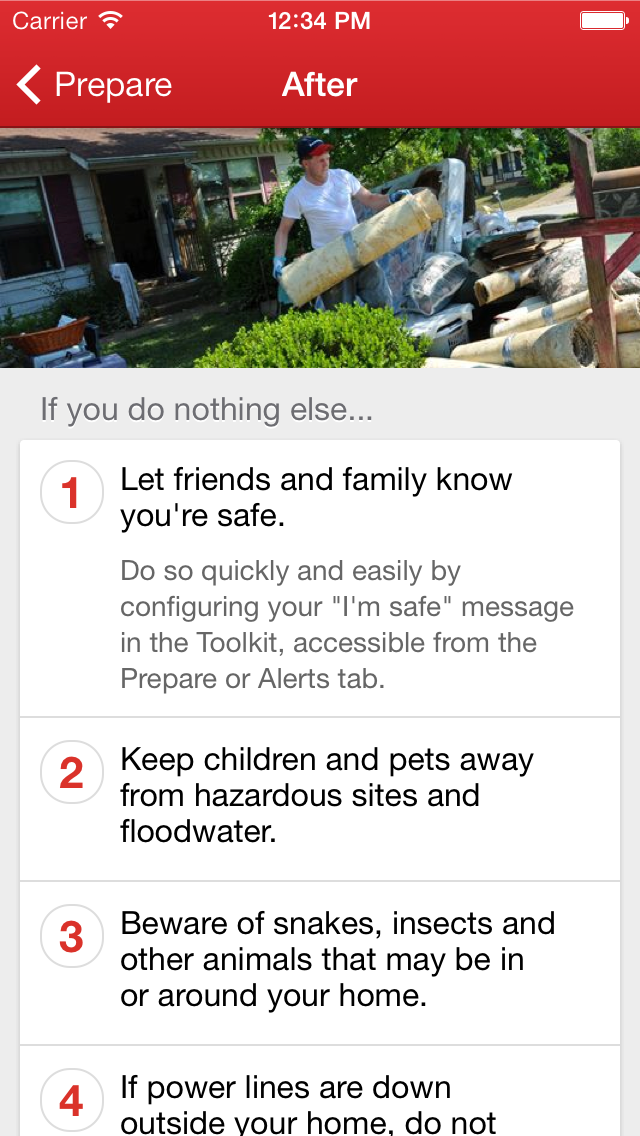
This app, available for iPhone, iPad and Android users, provides local and real-time information so you know what to do before during and after a flood.

Here are just a few of the awesome features this app includes:
  • Audible NOAA [National Oceanic and Atmospheric Administration] flood and flash flood watches and warnings so people can gather loved ones and head to safety
  • The alerts can save lives if users are asleep, away from radio, TV or in places where weather band radios may not work - users can even monitor alerts in other areas where loved ones live
  • An “I’m safe” button allows users to send a message letting family and friends know they are out of harm’s way
  • The app also has toolkit with flashlight, strobe light and alarm to let others know where you are and locations of open Red Cross shelters in case people need to evacuate
  • Recovery resources are included for when you are able to return home and start cleaning up

 According to the National Flood Insurance Program, floods are the most common natural disaster in the United States. Anything from heavy rain and melting snow or ice can saturate the ground and cause floods or flash floods.

Contrary to popular belief, the American Red Cross does not have boats and cannot always get to victims during a flood.

For example, our SUVs, pickups and large vehicles are not save to drive the flood waters. Two feet of water can float most vehicles and, if the water is moving quickly, vehicles can be swept away.

Anytime you come to a flooded road, turn around and go the other way. It’s better to be safe than sorry.

While you may think you can walk through the floodwaters, just six inches of swiftly moving water can sweep you off your feet. If the water is above your ankles, just turn around and go another way.

This app has resources developed by experts on how to prepare for flooding:

  • The content is available in English and Spanish based on the user language settings on their mobile device.
  • The app contains simple instructions and steps on what supplies to have, and how to develop an emergency plan if you have to stay put or if you must evacuate.
  • It also features interactive quizzes with badges that you can earn and share on social networks.
  • Preloaded content on the app gives users instant access to all information even without mobile connectivity.

The newest Flood App is just one in a series of emergency preparedness apps the American Red Cross is developing to put lifesaving information in the hands of people whenever and wherever they may need it. These apps can be in the Apple App Store and the Google Play store or by visiting the American Red Cross website.

It is always important to be prepared. If you would like to learn more about how you can help with American Red Cross and your community during a time of disaster please visit redcross.org/takeaclass.

Friday, March 14, 2014

Erin Imhoff volunteers for the feeling


By Kassidy Ketron
Intern

Erin Imhoff volunteers at Red Cross for the rewarding feeling she has knowing she is preparing people to save a life.

During her nine years at Red Cross, she has taught babysitters classes, wilderness first aid, CPR for the professional rescuer, and CPR for the first aid responder.

“I originally started with Red Cross in college because I needed to be recertified to work when I went back home,” Imhoff said. “And the woman who would be certifying me said that I would be a good candidate to teach Red Cross classes. So that’s how I got started.”

Teaching life saving skills is something she said she has really enjoyed about teaching the different classes at the American Red Cross.

“(I like) the fact that it’s not useless knowledge,” Imhoff said. “It’s actually knowledge that you can apply to make a difference or to actually save someone’s life.”

She is currently pursuing her master’s degree in social services at Lubbock Christian University and works at a local social services program, as well as volunteering for Red Cross.

When Imhoff isn’t teaching classes, she is responding to late night calls of a disaster like any Disaster Action Team Captain would. DAT is disaster response unit of people who respond to disasters at any time of the day, providing counseling, clean-up kits and shelters.

“I think sometimes it’s emotionally draining, especially when you have to get up at 3 a.m. and go out there,” she said. “It’s a lot of quickly preparing yourself to cope with someone else’s emotions. But, when all is said and done and you’ve taken care of business, it’s rewarding. It’s kind of like a natural high because you did something helpful, something that no one else could do at 3 a.m. but you.”

Even though Imhoff has school, work and volunteering to juggle she said it’s all about organization and time management.

She said at the end of the day, knowing she taught someone to save a life and gave them the knowledge they need, makes it all worth it.

“I think just in general, it’s all very rewarding, but on different levels,” she said. “Going out on a DAT call is different, it’s kind of more of them warm fuzzy (feelings). In regards to teaching classes, I think it’s just the idea that you empowered somebody to save someone’s life is very rewarding.”

Even after nine years, Imhoff still has a good time with the American Red Cross.

“I think it’s a lot of fun and I think it’s very rewarding to be able to provide assistance in someone’s time of need,” she said.

Although Imhoff has never had to use CPR on anyone, she knows how to save a life if she ever needs to because of her time with the American Red Cross.

“(With) Red Cross, I’ve got life saving skills,” she said. “I think overall, I think it’s a very supportive. The chapters are all very supportive of their volunteers and employees and I think that’s helpful to maintain and to make them want to be a part of Red Cross.”

To join Erin Imhoff and other hardworking volunteers at the South Plains Regional Chapter, visit our website and learn more.

Friday, February 28, 2014

Humanitarians to honor during Black History Month


By Kassidy Ketron

Intern


In honor of the end of Black History Month, we would like to remind you of a few very important people to the American Red Cross and how you can honor their memory.

Frances Elliot Davis

We’ll start with Frances Elliot Davis. She was born in 1881 in Shelby, North Carolina and was determined to chase her dreams of becoming a nurse during a time when it was difficult to do so for an African American woman.

She became one of the first African American women to be accepted to Freedman’s Hospital Training for Nurses and passed the exam given to white nurses, which was considered more rigorous, she became the first African American to attend the American Red Cross at Columbia University.

She served as director of nurses at a hospital, organized a training school for nurses, managed health clinics, established a day nursery and caught the attention of Eleanor Roosevelt, just to name a few of her accomplishments.

Davis spent most of her life dedicated to helping others and volunteering her time. Let her inspire you to volunteer your time and services to the American Red Cross.

Frederick Douglass  — photo courtesy of PBS

American antislavery author and activist Frederick Douglass is said to have assisted American Red Cross founder Clara Barton to rally national support for the organization.

Douglass and Barton met after the Civil War and Douglass lent his support in 1882 to the Red Cross “Appeal to the American People” to raise money to assist victims of the Mississippi River floods.

His support for Barton and the Red Cross led him to become one of the founding members and his early participation in its creation is said to have paved the way for Steve D. Bullock to become the American Red Cross’s first African American Acting President in 1999.

Not only did Douglass lead the early civil rights movement, but he recognized the importance of rallying support and funds for the American Red Cross.

To honor the memory of Douglass and help people in your community who have been affected by a disaster donate to your local chapter.

Jerome H. Holland

Jerome H. Holland, the Red Cross’ first African-American Chairman of the Board of Directors for the Red Cross, led the organization’s dedication to the health and well-being of victims needing blood services.

The volunteer position of Chairman is the highest leading official position in the Red Cross. He served as Chairman, until he passed away in New York on January 13, 1985. During his time as Chairman, he facilitated a positive relationship with the Red Crescent. The Red Cross renamed the research and development lab in honor of Dr. Holland in 1987.

Dr. Holland spent his life his life helping other. He served on nine boards of major U.S. companies, researched for the Pew Memorial Trust, was the first African American to be awarded the Theodore Roosevelt Award in 1972, as well as serving as the first African-American Chairman of Planned Parenthood in 1968.

In honor of the many things Dr. Holland did to help others and his country, find out ways you can prepare to help others by taking a class and becoming certified in one of the American Red Cross’ many certification classes.

The American Red Cross is proud to honor the many humanitarians who helped make the organization what it is today. Do your part in honoring these noble people by visiting our website and seeing how you can help.

Friday, February 14, 2014

Red Cross’ Guide to a Successful Valentine’s Day

Photo courtesy of blog.bookrenter.com

By Kassidy Ketron
Intern


Before you prepare a lavish meal for your sweetheart, light every candle in a five-mile radius, or prepare those chocolate covered strawberries sprinkled with nuts, the American Red Cross wants you to keep a few things in mind so this day of love isn’t ruined.

Whether you’re making a five-course meal or turning off all the lights in your home leaving candles as the only option, make sure you know what to do to prevent catching your apron or carpet on fire.
  • Stay in the kitchen when frying, grilling or broiling food. If you leave the kitchen, even for a short period of time, turn off the stove.
  • Stay in the home while simmering, baking, roasting or boiling food. Check it regularly and use a timer to remind you that food is cooking.
  • Keep anything that can catch fire—like pot holders, towels, plastic and clothing— away from the stove.
  • Keep pets off cooking surfaces and countertops to prevent them from knocking things onto the burner.

 If you fail to follow our preventative steps:
  • Ensure that all household members know two ways to escape from every room of your home.
  • Make sure everyone knows where to meet outside in case of fire.
  • Practice escaping from your home at least twice a year and at different times of the day. Practice waking up to smoke alarms, low crawling and meeting outside. Make sure everyone knows how to call 9-1-1.
  • Teach household members to STOP, DROP and ROLL if their clothes should catch on fire.

Click here for more information about fire prevention and what to do in case of one.

Assuming you’ve made or purchased a wonderful meal, you sit down with your honey to enjoy it, but they start choking because your charming self said something really funny.

Here’s what you do:
  • Hit them firmly on their back between the shoulder blades five times to dislodge the object.
  • Then, give five quick abdominal thrusts. Stand behind the choking victim, join your hands around their tummy and form a fist. Pull your hands sharply inward and upward. Don’t attempt this technique on a child under a year old.
  • Always call 911 or get someone else to do it when someone is choking.

Prepare yourself as much as possible for the unexpected by downloading the First Aid App by American Red Cross or visit our website to learn more about making sure your Valentine’s Day is disaster free. 

Friday, February 7, 2014

Celebrate Disaster Day in the best way

Photo courtesy of comicvine.com

By Kassidy Ketron
Intern

Can you believe Disaster Day has already come and gone? Neither can we.

What exactly is Disaster Day, you ask? We have no idea, but we thought it would be a great opportunity to give you some tips to avoid disaster and advice on what to do when it does strike.

Our first set of advice is to Be Red Cross Ready:
  • Know what emergencies or disasters are most likely to occur in your community
  • Have a family disaster plan and practice it
  • Have an emergency preparedness kit
  • Make sure at least one member of the household is trained in first aid and CPR/AED
  • Take action to help your community to prepare
In the event of a disaster, it’s important to be ready and prepared. Compile a survival kit that you can use at home or easily take with you in case of evacuation.

Here are just a few of the things we suggest you store in your kit:
  • Water — one gallon per person, per day (3-day supply for evacuation, 2-week supply for home)
  • Food — non-perishable, easy-to-prepare items (3-day supply for evacuation, 2-week supply for home)
  • Flashlight
  • Battery-powered or hand-crank radio (NOAA Weather Radio, if possible)
  • Extra batteries
  • First aid Kit — Anatomy of a First Aid Kit
  • Medications (7-day supply) and medical items
  • Copies of personal documents (medication list and pertinent medical information, proof of address, deed/lease to home, passports, birth certificates, insurance policies)
  • Extra cash
  • Click here to read the complete list.
Not only is it important to have a survival kit ready, but a preparedness plan can be just as vital.

To make sure you stay safe:
  • Meet with your family or household members
  • Identify responsibilities for each member of your household and plan to work together as a team
  • If a family member is in the military, plan how you would respond if they were deployed
If separated:
  • Choose two places to meet:
    • Right outside your home in case of a sudden emergency, such as a fire
    • Outside your neighborhood, in case you cannot return home or are asked to evacuate
  • Choose an out-of-area emergency contact person. It may be easier to text or call long distance if local phone lines are overloaded or out of service. Everyone should have emergency contact information in writing or saved on their cell phones.
If you evacuate:
  • Decide where you would go and what route you would take to get there. You may choose to go to a hotel/motel, stay with friends or relatives in a safe location or go to an evacuation shelter, if necessary.
  • Practice evacuating your home twice a year. Drive your planned evacuation route and plot alternate routes on your map in case roads are impassable.
  • Plan ahead for your pets. Keep a phone list of pet-friendly hotels/motels and animal shelters that are along your evacuation routes.
Make sure you can expect the unexpected, or at least prepare for it as much as possible, by visiting our website and educating yourself.

Now that you are all set, enjoy your day and stay safe. Next year, show Disaster Day what you’re made of.

Monday, February 3, 2014

Groundhog Phil saw his shadow. Now what?


Photo courtesy of groundhog.org

By Kassidy Ketron
Intern

As if we haven’t seen enough crazy weather this winter season, Groundhog Phil saw his shadow Sunday, signifying six more weeks of winter.

Although a groundhog’s shadow is straightforward with its weather predictions, sometimes the weatherman’s terminology can be a little confusing.

So, here’s what all of that means:
  • Winter Storm Outlook — Winter storm conditions are possible in the next 2 to 5 days.
  • Winter Weather Advisory — Winter weather conditions are expected to cause significant inconveniences and may be hazardous. When caution is used, these situations should not be life threatening.
  • Winter Storm Watch — Winter storm conditions are possible within the next 36 to 48 hours. People in a watch area should review their winter storm plans and stay informed about weather conditions.
  • Winter Storm Warning — Life-threatening, severe winter conditions have begun or will begin within 24 hours. People in a warning area should take precautions immediately.
When there is a warning for winter weather, do your best to make sure you’re prepared for anything from icy roads to a blizzard.
  • Winterize — Keep the gas tank in your vehicle full. This will keep the fuel line from freezing.
  • Insulate — Keep your home insulated by installing storm windows or covering windows with plastic from the inside to keep the cold air out.
  • Maintain — Keep up with heating equipment and chimneys by having them cleaned regularly and inspected every year.
  • Travel — Keep the heat on in your home if you decide to leave during cold weather. Make sure the temperature is set no lower than 55 ° F.
Occasionally, the South Plains Region will see enough bad winter weather to shut down what seems like entire cities. Do you remember the blizzard that hit the Lubbock area last April?
Photo courtesy of srh.noaa.org
When such weather hits, here is what you need to know:
  • Running water — Keep the water running, even at a trickle, to prevent pipes from freezing.
  • Cabinet doors — Open kitchen and bathroom cabinet doors so warm air can circulate around the plumbing. Don’t forget to move any harmful cleaners or household chemicals out of the reach of children.
  • Heat — Keep the thermostat set at a constant temperature throughout the day and night. By temporarily suspending the use of lower nighttime temperatures, you may incur a higher heating bill.
  • Driving — Avoid hitting the road when conditions include sleet, freezing rain or drizzle, snow or dense fog. When travel is absolutely necessary, keep a disaster supplies kit in your vehicle.
To find out more ways to stay safe during bad weather click here.

Making sure you know what the weatherman is saying and how to prepare for any kind of winter is storm is vital, but let’s not forget about the fur babies, and we don’t mean hairy children.
  • Pets/companion animals — Bring them inside during winter weather. Move other animals or livestock to sheltered areas and make sure that their access to food and water is not blocked by snow drifts, ice or other obstacles.
Be sure you are ready to take care of yourself and loved ones when bad weather hits by visiting our website or downloading one of our weather and safety mobile apps.

Friday, January 31, 2014

How To Not Ruin Your Super Bowl XLVIII Sunday


By Kassidy Ketron

Intern


What better way to spend Super Bowl Sunday than cooking out on the grill with family and friends, right? But, do you know how to prevent a fire? Would you know what to do if one started? (Hint: fanning it or throwing more lighter fluid on it is the wrong answer.)

To prevent a fire:
  • Stay in the kitchen when frying, grilling or broiling food. If you leave the kitchen, even for a short period of time, turn off the stove.
  • Stay in the home while simmering, baking, roasting or boiling food. Check it regularly and use a timer to remind you that food is cooking.
  • Keep anything that can catch fire—like pot holders, towels, plastic and clothing— away from the stove.
  • Keep pets off cooking surfaces and countertops to prevent them from knocking things onto the burner.

If you need to put out a fire:
  • Ensure that all household members know two ways to escape from every room of your home.
  • Make sure everyone knows where to meet outside in case of fire.
  • Practice escaping from your home at least twice a year and at different times of the day. Practice waking up to smoke alarms, low crawling and meeting outside. Make sure everyone knows how to call 9-1-1.
  • Teach household members to STOP, DROP and ROLL if their clothes should catch on fire.
  • Click here for more information about fire prevention and what to do in case of one.

Inevitably, someone is going to be chewing on their food, get excited/upset about a play and choke on their food. Although your first reaction may be to point and laugh — don’t. Choking is a serious matter and it’s time for you to save your buddy’s life.

According to the First Aid App by American Red Cross, here’s what you should do:
  • Hit them firmly on their back between the shoulder blades five times to dislodge the object.
  • Then, give five quick abdominal thrusts. Stand behind the choking victim, join your hands around their tummy and form a fist. Pull your hands sharply inward and upward. Don’t attempt this technique on a child under a year old.
  • Always call 911 or get someone else to do it when someone is choking.

Regardless of the team’s jersey they are wearing, is one of your guests looking a little rough? Are you not feeling like a winner yourself? One or both of you could have the flu.

  • Before the guests huddle up at the party, hosts should make sure there is plenty of soap and disposal hand towels or paper towels in the bathroom.
  • Pro players don’t share water bottles, so don’t let anyone else drink out of your glass, cup, can or bottle. Write names on the cups or mark them in some way to keep them separate and defend against mix ups.
  • If your team scores a touchdown or makes a big play, avoid the kisses or high fives with friends. Try an elbow bump or your own individual touchdown dance.

Prepare yourself as much as possible for the unexpected by downloading the First Aid App by American Red Cross or visit our website to learn more about making sure your Super Bowl Sunday is fun and safe. 

Monday, January 14, 2013

Steps to Help Kids Avoid the Flu

Health officials are reporting widespread influenza outbreaks in 47 of 50 states, up from just a week ago. One age group hit particularly hard is children and the American Red Cross has some steps parents can teach their kids to help them avoid getting sick.

Some children have gotten so sick they have had to be hospitalized. According to the Centers for Disease Control, while some of the children hospitalized had underlying medical conditions such as asthma, more than 40 percent of hospitalized children had no other medical conditions.

Washing Hands

Kids have a way of picking up colds and other illnesses. Parents should teach children proper hand washing techniques and how to correctly cover coughs or sneezes. Washing hands properly is an important step to avoid getting the flu. Wash hands with soap and warm water. When using soap and water:

  • Wash for at least 20 seconds, covering the entire hand including fingernails and under jewelry. Younger children can be taught to sing a short song like "Row, Row, Row Your Boat," or the "Happy Birthday" song a few times, which will ensure they wash for at least 20 seconds.
  • Rinse and dry thoroughly with a disposable towel.
  • Use the towel to turn off the faucet.

If using an alcohol-based hand sanitizer:

  • Rub thoroughly over the entire hand, including nail areas and between the fingers.
  • Continue to rub until the product dries.

The Scrub Club®

The American Red Cross and NSF International have collaborated to help parents and teachers reinforce kids' hand-washing habits. The Scrub Club® is an interactive Web site that offers free materials to raise awareness about the benefits of hand washing to fight germs and prevent illness. The website features cartoon Webisodes featuring seven soaper-heroes and comes complete with educational materials, music and games. Visit ScrubClub.org for more information.

Sneezing and Coughing

If a child has to cough or sneeze, parents should teach them to cover their mouth and nose with a tissue and wash their hands afterwards. If they don’t have a tissue, they should be taught to cough or sneeze into their elbow or upper arm, not their hands.

Kids should also be taught to avoid sharing such things as utensils, cups and bottles, and to keep their hands away from their eyes, nose and mouth.

Safety Steps

The most important thing parents can do is get children six months of age or older a flu vaccine as recommended by the Centers for Disease Control. Children’s caregivers should also get vaccinated. Other steps parents can take include:

  • Keep surfaces like bedside tables, surfaces in the bathroom, kitchen counters and toys for children clean by wiping them down with a household disinfectant.
  • If someone in the household is sick, try to keep the sick person in a separate room from others in the household, if possible.

If the Child Becomes Ill

If a child gets sick, parents should consult their doctor. They should also make sure their child gets plenty of rest and fluids. If the child is breathing fast or having trouble breathing, has bluish or gray skin color, refuses to drink, is vomiting, is irritable or has trouble staying awake, parents should get the child medical help right away. The child should stay home from school or day care until at least 24 hours after their fever is gone.

More Flu Facts

Information on what to do if someone has the flu is available as part of the free Red Cross First Aid mobile app available for iPhone and Android devices. You can find more information about how to help keep you and your loved ones protected by visiting redcross.org/FluTips.