Showing posts with label Plan and Prepare. Show all posts

Thursday, May 15, 2014

The Reason You Need the Wildfire App: Red Flag Warnings

Photo courtesy of the National Weather Service.


By Kassidy Ketron, Intern

In the South Plains it’s not uncommon for Red Flag warnings, especially during the drought.

A red flag warning, according to National Weather Service, means that conditions are occurring or will occur which could lead to the development of large and dangerous fires.

Because of the dry climate, we think it’s important you know what to do in case there is a wildfire near your or your loved ones.

The American Red Cross’ Wildfire App for iPhone and Android is a great way to do that. It’s features include:
  • Step-by-step instructions let you know what to do even before/during/after wildfires, even if there is no data connectivity.
  • Wildfire News section with state-by-state links to all fire-fighting agencies’ Twitter feeds and websites ensuring the most recent developments on current wildfires.
  • Click-to-call access to your state’s 511 network for the latest traffic information in case of evacuation.
  • Let family and friends know you are okay with the customizable “I’m Safe” alert for Facebook, Twitter, email and text.
  • Find open Red Cross shelters in your area when you need help.
  • Stay safe when the lights are out with the Toolkit, including a strobe light, flashlight and audible alert functions.
  • Prepare for the worst by learning how to assemble an emergency kit for your family in the event of power outage or evacuation.
  • Earn badges that you can share with your friends and show off your wildfire knowledge with interactive quizzes.

Empower your family to stay safe and remain calm in an emergency by learning how to make and practice your family disaster plan.
  • Meet with your family or household members.
  • Discuss how to prepare and respond to emergencies that are most likely to happen where you live, learn, work and play.
  • Identify responsibilities for each member of your household and plan to work together as a team.
  • If a family member is in the military, plan how you would respond if they were deployed.
  • Plan what to do in case you are separated during an emergency
  • Plan what to do if you have to evacuate 


It’s never a bad idea to get ready for the wildest weather, especially if you live in West Texas, so download the Wildfire app and stay safe!

Sunday, March 16, 2014

Be Prepared for National Flood Safety Awareness Week with the Flood App


By Kassidy Ketron

Intern


Unless you can swim like a fish or have the perfect boat for all occasions, chances are you might need to know more about what to do in the case of a flood.

In honor of National Flood Safety Awareness Week, what better time for the American Red Cross to release its newest Flood App to help save lives and reduce losses from floods and flash floods.

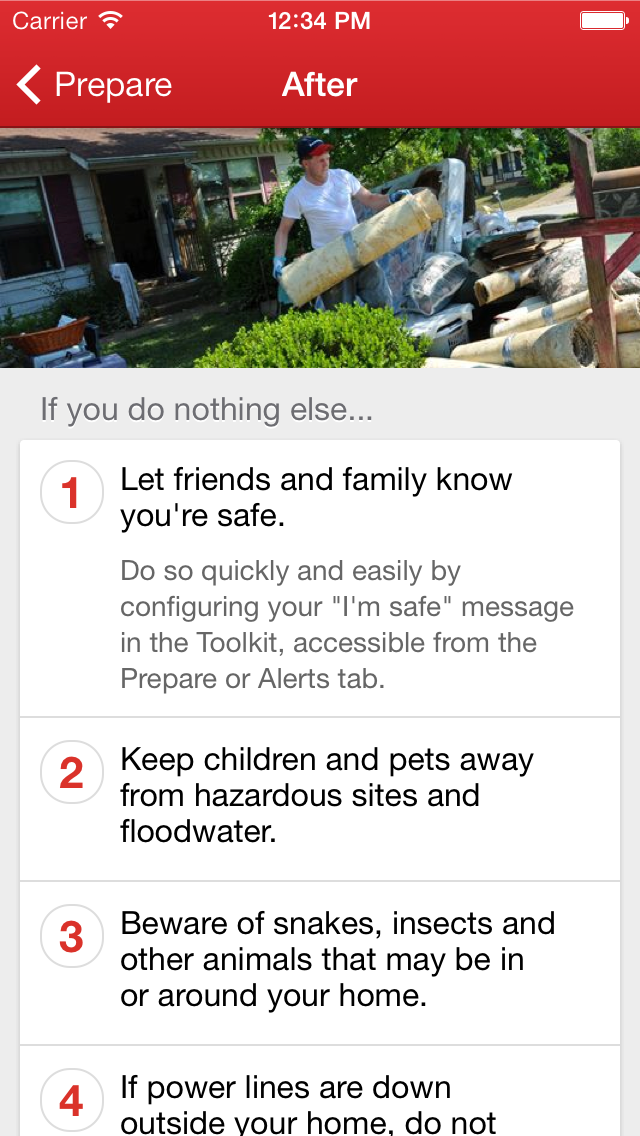
This app, available for iPhone, iPad and Android users, provides local and real-time information so you know what to do before during and after a flood.

Here are just a few of the awesome features this app includes:
  • Audible NOAA [National Oceanic and Atmospheric Administration] flood and flash flood watches and warnings so people can gather loved ones and head to safety
  • The alerts can save lives if users are asleep, away from radio, TV or in places where weather band radios may not work - users can even monitor alerts in other areas where loved ones live
  • An “I’m safe” button allows users to send a message letting family and friends know they are out of harm’s way
  • The app also has toolkit with flashlight, strobe light and alarm to let others know where you are and locations of open Red Cross shelters in case people need to evacuate
  • Recovery resources are included for when you are able to return home and start cleaning up

 According to the National Flood Insurance Program, floods are the most common natural disaster in the United States. Anything from heavy rain and melting snow or ice can saturate the ground and cause floods or flash floods.

Contrary to popular belief, the American Red Cross does not have boats and cannot always get to victims during a flood.

For example, our SUVs, pickups and large vehicles are not save to drive the flood waters. Two feet of water can float most vehicles and, if the water is moving quickly, vehicles can be swept away.

Anytime you come to a flooded road, turn around and go the other way. It’s better to be safe than sorry.

While you may think you can walk through the floodwaters, just six inches of swiftly moving water can sweep you off your feet. If the water is above your ankles, just turn around and go another way.

This app has resources developed by experts on how to prepare for flooding:

  • The content is available in English and Spanish based on the user language settings on their mobile device.
  • The app contains simple instructions and steps on what supplies to have, and how to develop an emergency plan if you have to stay put or if you must evacuate.
  • It also features interactive quizzes with badges that you can earn and share on social networks.
  • Preloaded content on the app gives users instant access to all information even without mobile connectivity.

The newest Flood App is just one in a series of emergency preparedness apps the American Red Cross is developing to put lifesaving information in the hands of people whenever and wherever they may need it. These apps can be in the Apple App Store and the Google Play store or by visiting the American Red Cross website.

It is always important to be prepared. If you would like to learn more about how you can help with American Red Cross and your community during a time of disaster please visit redcross.org/takeaclass.

Friday, March 7, 2014

Severe Weather Awareness Week — Make Sure You Are Prepared


Photo courtesy of National Weather Service

By Kassidy Ketron
Intern


It’s Severe Weather Awareness Week, which means it’s time to make sure you are prepared in case bad weather hits your city.


  • What hazardous weather can affect the area where you live and work and how could it impact you and your family?
  • Bookmark weather.gov to get the latest forecast information
  • Follow the National Weather Service on Facebook and Twitter
  • Read the State of the Climate reports to discover historical trends

2. Emergency Preparedness Kit

Before disaster strikes it’s a good idea to have supplies prepared that you might not otherwise think to get during the fact.

At minimum, you should have:
  • Water—one gallon per person, per day (3-day supply for evacuation, 2-week supply for home)
  • Food—non-perishable, easy-to-prepare items (3-day supply for evacuation, 2-week supply for home)
  • Flashlight
  • Battery-powered or hand-crank radio (NOAA Weather Radio, if possible)
  • Extra batteries
  • First aid kit – Anatomy of a First Aid Kit
  • Medications (7-day supply) and medical items
  • Multi-purpose tool
  • Sanitation and personal hygiene items
  • Copies of personal documents (medication list and pertinent medical information, proof of address, deed/lease to home, passports, birth certificates, insurance policies)
  • Cell phone with chargers
  • Family and emergency contact information
  • Extra cash
  • Emergency blanket
  • Map(s) of the area 

3. Family Disaster Plan

It is important for your family to be as prepared as possible when faced in case of emergency, which is why we think you need to make plans and practice what you would do in such an event.
  • Meet with your family or household members.
  • Discuss how to prepare and respond to emergencies that are most likely to happen where you live, learn, work and play.
  • Identify responsibilities for each member of your household and plan to work together as a team.
  • If a family member is in the military, plan how you would respond if they were deployed.
  • Plan what to do in case you are separated during an emergency
  • Plan what to do if you have to evacuate 

4. First aid and CPR/AED certified

You never know what might happen during severe weather. Planning for the worst, isn’t always a bad thing. Make sure at least one person in your household is first aid and CPR/AED certified.

Severe Weather Awareness Week is a great time to learn more about where you live and the weather that can affect you. It’s also a great time to get prepared. For more information visit our website.

Tuesday, February 25, 2014

Four Easy Ways You Can Be Humble on Be Humble Day


By Kassidy Ketron
Intern

In Honor of Be Humble Day that was on Saturday, we would like to show you a few easy ways you can be humble and give back to your community.

1. When a family on your neighborhood is woken up in the middle of the night by a fire the American 
Red Cross will be there to help them. To do that, though, the Red Cross needs your help.

Your monetary donations help us provide warm meals, clothes and every day necessities that are lost in a fire. This means you are helping people in your community when they need it the most. It’s not time consuming and very easy, which is a great thing and you are able to offer support to someone who has lost everything.

2. When a fire wreaks havoc on a home, the whole family is affected and the smallest victims, the children, may find comfort in something soft and cuddly to hold on to.

The American Red Cross has just the thing. By adopting Piper the Puppy, you can comfort a child who has just experienced devastation by helping them to know you care and are there to help. By adopting Piper the Puppy for $100, not only can bring a smile to a child’s face, but your name is also written on the paw so they know who cares.

3. Donating blood also is another great way to help people not only in your community, but across the country, as well. Up to one pint of blood can save three lives and what better gift than the gift of life? Donating blood is quick and a wonderful way to offer your support.

4. If you are interested in getting more involved with the American Red Cross, another great way to celebrate Be Humble Day is by signing up to participate in the South Plains Regional Chapter’s Strikes, Spares and Super Heroes: Red Cross Heroes Bowling for Relief event. It’s a great way to help provide support to those who could be affected by disaster at any moment. Your participation in this event will help provide those warm meals and necessities to someone who could be just down the street or across town.

Disaster are almost always unexpected, but with your donation, Piper the Puppy adoption, or blood donation, you can help the American Red Cross be as prepared as possible for when tragedy strikes.

Friday, February 7, 2014

Celebrate Disaster Day in the best way

Photo courtesy of comicvine.com

By Kassidy Ketron
Intern

Can you believe Disaster Day has already come and gone? Neither can we.

What exactly is Disaster Day, you ask? We have no idea, but we thought it would be a great opportunity to give you some tips to avoid disaster and advice on what to do when it does strike.

Our first set of advice is to Be Red Cross Ready:
  • Know what emergencies or disasters are most likely to occur in your community
  • Have a family disaster plan and practice it
  • Have an emergency preparedness kit
  • Make sure at least one member of the household is trained in first aid and CPR/AED
  • Take action to help your community to prepare
In the event of a disaster, it’s important to be ready and prepared. Compile a survival kit that you can use at home or easily take with you in case of evacuation.

Here are just a few of the things we suggest you store in your kit:
  • Water — one gallon per person, per day (3-day supply for evacuation, 2-week supply for home)
  • Food — non-perishable, easy-to-prepare items (3-day supply for evacuation, 2-week supply for home)
  • Flashlight
  • Battery-powered or hand-crank radio (NOAA Weather Radio, if possible)
  • Extra batteries
  • First aid Kit — Anatomy of a First Aid Kit
  • Medications (7-day supply) and medical items
  • Copies of personal documents (medication list and pertinent medical information, proof of address, deed/lease to home, passports, birth certificates, insurance policies)
  • Extra cash
  • Click here to read the complete list.
Not only is it important to have a survival kit ready, but a preparedness plan can be just as vital.

To make sure you stay safe:
  • Meet with your family or household members
  • Identify responsibilities for each member of your household and plan to work together as a team
  • If a family member is in the military, plan how you would respond if they were deployed
If separated:
  • Choose two places to meet:
    • Right outside your home in case of a sudden emergency, such as a fire
    • Outside your neighborhood, in case you cannot return home or are asked to evacuate
  • Choose an out-of-area emergency contact person. It may be easier to text or call long distance if local phone lines are overloaded or out of service. Everyone should have emergency contact information in writing or saved on their cell phones.
If you evacuate:
  • Decide where you would go and what route you would take to get there. You may choose to go to a hotel/motel, stay with friends or relatives in a safe location or go to an evacuation shelter, if necessary.
  • Practice evacuating your home twice a year. Drive your planned evacuation route and plot alternate routes on your map in case roads are impassable.
  • Plan ahead for your pets. Keep a phone list of pet-friendly hotels/motels and animal shelters that are along your evacuation routes.
Make sure you can expect the unexpected, or at least prepare for it as much as possible, by visiting our website and educating yourself.

Now that you are all set, enjoy your day and stay safe. Next year, show Disaster Day what you’re made of.