Showing posts with label Red Cross. Show all posts

Tuesday, September 12, 2017

HURRICANE HARVEY FAST FACTS

HURRICANE HARVEY FAST FACTS
September 12, 2017

The American Red Cross continues to work around the clock to provide shelter, food, comfort and other emergency support to victims of Hurricane Harvey.

  • Overnight, more than 5,000 people sought refuge in 30 Red Cross and partner shelters across Texas. To date, there have been more than 364,000 overnight shelter stays for Hurricane Harvey.
  • Along with our partners, we have served almost 1.7 million meals and snacks in Texas. 
  • More than 3,200 Red Cross disaster workers are on the ground in Texas, with more than 475 on the way.
  • Almost 190 emergency response vehicles have been activated to help deliver meals and relief supplies.
  • Mental health and health services professionals have provided more than 57,000 contacts to provide support and care to those affected.
  • We’ve distributed more than 383,000 relief items like diapers, bug spray, cleaning supplies, coolers, and comfort kits that contain deodorant, toothbrushes, toothpaste and other hygiene items in Texas.
  • More than 64 million hurricane and flood alerts have been issued through Red Cross mobile apps for Hurricanes Harvey and Irma. The apps provide shelter locations and real-time information so people can help protect themselves and their loved-ones.       

HURRICANE IRMA FAST FACTS

HURRICANE IRMA FAST FACTS
September 12, 2017

The American Red Cross has a massive relief effort underway to provide safe shelter to people in the path of Irma’s fury. The Red Cross is part of a large team of agencies and organizations responding to provide help to those in need.

  • Overnight, an estimated 108,000 people were provided refuge from Hurricane Irma in as many as 530 government and Red Cross evacuation centers across 6 states, Puerto Rico and the U.S. Virgin Islands. This includes:
    • In Florida, an estimated 100,300 people in 427 evacuation centers.
    • In Georgia, more than 5,500 people in over 40 evacuation centers.
    • In Alabama, about 500 people in 20 evacuation centers.
    • In South Carolina, about 1,000 people in 23 evacuation centers.
    • On the U.S. Virgin Islands, almost 300 people in 5 evacuation centers. 
    • In Puerto Rico, 170 people in 7 evacuation centers.
    • In Tennessee, 134 people in 5 evacuation centers.
    • In North Carolina, 72 people in 5 evacuation centers.
  • To date, evacuation centers have provided more than 485,000 overnight stays to people needing a safe place to go.
  • More than 2,600 Red Cross workers are responding to Irma now, with 500 more volunteers on the way.
  • More than 100 emergency response vehicles have been activated to help.
  • More than 64 million hurricane and flood alerts have been issued through Red Cross mobile apps for Hurricanes Harvey and Irma. The apps provide shelter locations and real-time information so people can help protect themselves and their loved-ones.       

Wednesday, May 3, 2017

Severe Storms: Delivering Relief to Families


I want to update you on our response to last weekend’s severe storms—which devastated hundreds of homes across the Southern Plains and Mississippi Valley. We want to make sure everyone stays safe. If you have loved ones or friends in affected areas, please share our free Emergency App with safety tips, shelter locations and severe weather alerts. Download the app by searching “American Red Cross” in the Apple App Store or Google Play.

Across several states, Red Cross volunteers and staff are working tirelessly to deliver food, shelter and comfort. In Texas, tornadoes flattened neighborhoods, and more than 100 people were rescued from rising waters in Missouri. Powerful winds and floods also ravaged homes in Arkansas, Mississippi and Oklahoma.

The needs are dire—and we’re ramping up a big response to help. Since Saturday, we’ve provided more than 700 overnight stays for people seeking refuge in 43 Red Cross and community shelters. We’re also delivering nourishing meals, snacks and comfort kits with necessities like toothbrushes for people who lost so much. In addition, trained workers are offering health services, such as replacing lost prescription medications, and emotional support to help families coping with the trauma of the storms.

As areas become safe to enter, we’ll continue assessing damage to hard-hit neighborhoods like the one below in Texas. We’re also working closely with local partners to address people’s urgent needs and to closely monitor this week’s severe weather threats—which could worsen conditions.


We need your support to continue helping people devastated by disasters like severe storms—and countless other crises that occur every day. Families who live through these traumatic events rely on compassionate individuals like you for relief and hope.

If you want to help today, please contact me at 806-765-8534

Thank you,

Laura Hann
Executive Director
American Red Cross
Serving the Texas South Plains

Monday, December 5, 2016

When Texas Was at the Bottom of the Sea - A new Red Cross volunteers reflections

If volunteering is to be viewed as a sacrifice for one’s community, volunteering with the Red Cross may be spoiling me. I have been volunteering with the Red Cross for just over a month now, and the relationships and opportunities I have found here have made it more of a pleasure to volunteer than a sacrifice.

Growing up in Lubbock, it has always been a little difficult to feel connected with the outside world. As the 2015 Smithsonian Magazine article, “When Texas Was at the Bottom of the Sea” shows, Lubbock used to be an ocean bed of a vast and expansive ocean. Today it is still easy to look out over the grand vistas of farms and prairies and be overtaken by the same feeling of vastness as if looking out over the sea. After all, we are hundreds of miles away from Texas’ large cities (sorry Amarillo!) and thousands of miles away from the countries that are in desperate need of humanitarian aid. Growing up on the edge of Lubbock, it has always been easy to feel far away from the rest of the world.

I have only been with the Red Cross for a month now, but the opportunities and the world-wide actions the Red Cross provides has been incredibly inspiring. For example, the International Committee of the Red Cross is currently sheltering 20,000 refugees from Aleppo, Syria (http://abcnews.go.com/International/wireStory/latest-strengthening-humanitarian-presence-aleppo-43898108). In Senegal, Senegalese Red Cross volunteers just finished another distribution of food vouchers to communities afflicted by low rainfall rates. (http://www.ifrc.org/en/news-and-media/news-stories/africa/senegal/senegal-red-cross-and-echo-bring-a-smile-back-to-thousands-of-families-affected-by-food-insecurity-73729/). To be apart of such an organization, even if I am thousands of miles away, is an honor in itself.

            Not only is it an honor to be apart of an organization that is capable of extending such humanitarian aid, but the American Red Cross also provides opportunities to learn and grow as a volunteer. It was to my complete surprise that the Red Cross has an extensive online education program, capable of training me to become more skilled in plenty of different skill sets, including logistics, disaster services, finances and communications. This has been a huge help for me – as a college senior, the only things I feel truly skilled at doing are studying and power-napping, neither of which are particularly useful in the world of disaster response and aid. In these days of expensive higher education, the importance of free training for curious volunteers cannot be overstated. In my time volunteering in Lubbock there have been few opportunities to grow while serving a community, and I am exciting to have the opportunity.

            It is obvious I still have a long way to go before I can help the villages of Senegal or aid refugees in Syria. My foreign language studies have a long way to go, (Je voudrai visiter le Sénégal bientôt, mais les francophones parlent très rapidement. Mais, j’essaie.), my Disaster Response training is just shy of being completed and my graduation in May I will be faced with paying off college debt.


            Yet though I am far away, the Red Cross is allowing me to serve my community while continuing to grow. This is what brings me back each week, and why I considered myself spoiled. Even if the only way I can help currently is making phone calls to ask for donations and cleaning supply closets, I feel much closer to the outside world than before.

Guest Blogger Jerrod Miller

Monday, August 15, 2016

Louisiana and Southeast Floods


Click here for video update


Louisiana and Southeast Floods
The flooding in Louisiana is likely the worst natural disaster since Superstorm Sandy in 2012. The historic flooding began to take shape Friday and continued through the weekend as rain came down on the southern Louisiana region. The situation in Louisiana is extremely chaotic and gaining access to many areas is difficult due to flooding and numerous road closures. In addition, power and phone outages are complicating relief efforts. Local officials have reported 20,000 water rescues and are estimating that 10,000 homes have been impacted. With the ongoing floods, many areas remain inaccessible. The threat of ongoing floods continue as weather experts predict more rain is possible.

More than 1,700 National Guard troops have been mobilized with more on the way. On Sunday evening the President declared a major disaster in Louisiana including the most heavily parishes of Tangipahoa, St. Helena, East Baton Rouge and Livingston. This list is expected to grow. Mandatory evacuations remain in effect for the town of Lake Arthur in the Jefferson Davis Parish.

On Sunday night, more than 10,600 people sought refuge in nearly 50 Red Cross and community shelters across Louisiana. In addition to opening and supporting shelters, Red Cross disaster volunteers are providing shelter, food and comfort now with more help on the way. An additional 500 Red Cross disaster volunteers from all over the country are on their way to help in Louisiana. The Red Cross has also mobilized 60 disaster response vehicles, 40,000 ready-to-eat meals, and more than two dozen trailer loads of shelter and kitchen supplies.

Preliminary estimates indicate the Red Cross response efforts could cost more than $10 million and it is likely to change as more information becomes available.

Large disasters like the floods in Louisiana create more needs than any one organization can meet and the Red Cross is working closely with the entire response community – federal, state, county and local agencies, and other non-profit organizations, churches, area businesses and others- to coordinate relief efforts and deliver help quickly and efficiently, keeping in mind the diverse needs of the community. Some of these organizations include the Southern Baptists Disaster Relief, Save the Children and AmeriCorps National Civilian Community Corps.

Because the flooding isn’t over, it will take some time to fully uncover the extent of the devastation once the water recedes and the Red Cross will work closely with its partners to ensure people receive the help they need as quickly as possible.


In Mississippi, rainfall is continuing causing additional flooding. The governor of Mississippi issued a state of emergency for Adams, Amite, Pike, Wilkinson and other counties affected by the rain and floods over the last several days. Mandatory evacuations are still in place for Crosby and Osyka. The Red Cross is coordinating with local emergency management to provide assistance as necessary. 

Sunday, March 16, 2014

Be Prepared for National Flood Safety Awareness Week with the Flood App


By Kassidy Ketron

Intern


Unless you can swim like a fish or have the perfect boat for all occasions, chances are you might need to know more about what to do in the case of a flood.

In honor of National Flood Safety Awareness Week, what better time for the American Red Cross to release its newest Flood App to help save lives and reduce losses from floods and flash floods.

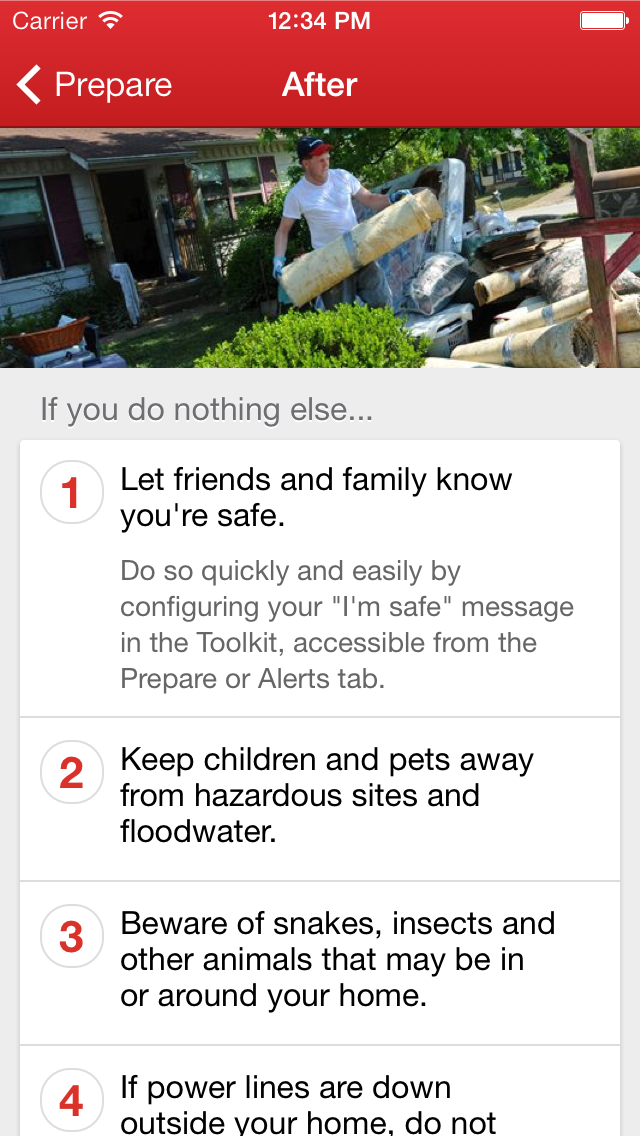
This app, available for iPhone, iPad and Android users, provides local and real-time information so you know what to do before during and after a flood.

Here are just a few of the awesome features this app includes:
  • Audible NOAA [National Oceanic and Atmospheric Administration] flood and flash flood watches and warnings so people can gather loved ones and head to safety
  • The alerts can save lives if users are asleep, away from radio, TV or in places where weather band radios may not work - users can even monitor alerts in other areas where loved ones live
  • An “I’m safe” button allows users to send a message letting family and friends know they are out of harm’s way
  • The app also has toolkit with flashlight, strobe light and alarm to let others know where you are and locations of open Red Cross shelters in case people need to evacuate
  • Recovery resources are included for when you are able to return home and start cleaning up

 According to the National Flood Insurance Program, floods are the most common natural disaster in the United States. Anything from heavy rain and melting snow or ice can saturate the ground and cause floods or flash floods.

Contrary to popular belief, the American Red Cross does not have boats and cannot always get to victims during a flood.

For example, our SUVs, pickups and large vehicles are not save to drive the flood waters. Two feet of water can float most vehicles and, if the water is moving quickly, vehicles can be swept away.

Anytime you come to a flooded road, turn around and go the other way. It’s better to be safe than sorry.

While you may think you can walk through the floodwaters, just six inches of swiftly moving water can sweep you off your feet. If the water is above your ankles, just turn around and go another way.

This app has resources developed by experts on how to prepare for flooding:

  • The content is available in English and Spanish based on the user language settings on their mobile device.
  • The app contains simple instructions and steps on what supplies to have, and how to develop an emergency plan if you have to stay put or if you must evacuate.
  • It also features interactive quizzes with badges that you can earn and share on social networks.
  • Preloaded content on the app gives users instant access to all information even without mobile connectivity.

The newest Flood App is just one in a series of emergency preparedness apps the American Red Cross is developing to put lifesaving information in the hands of people whenever and wherever they may need it. These apps can be in the Apple App Store and the Google Play store or by visiting the American Red Cross website.

It is always important to be prepared. If you would like to learn more about how you can help with American Red Cross and your community during a time of disaster please visit redcross.org/takeaclass.

Friday, March 14, 2014

Erin Imhoff volunteers for the feeling


By Kassidy Ketron
Intern

Erin Imhoff volunteers at Red Cross for the rewarding feeling she has knowing she is preparing people to save a life.

During her nine years at Red Cross, she has taught babysitters classes, wilderness first aid, CPR for the professional rescuer, and CPR for the first aid responder.

“I originally started with Red Cross in college because I needed to be recertified to work when I went back home,” Imhoff said. “And the woman who would be certifying me said that I would be a good candidate to teach Red Cross classes. So that’s how I got started.”

Teaching life saving skills is something she said she has really enjoyed about teaching the different classes at the American Red Cross.

“(I like) the fact that it’s not useless knowledge,” Imhoff said. “It’s actually knowledge that you can apply to make a difference or to actually save someone’s life.”

She is currently pursuing her master’s degree in social services at Lubbock Christian University and works at a local social services program, as well as volunteering for Red Cross.

When Imhoff isn’t teaching classes, she is responding to late night calls of a disaster like any Disaster Action Team Captain would. DAT is disaster response unit of people who respond to disasters at any time of the day, providing counseling, clean-up kits and shelters.

“I think sometimes it’s emotionally draining, especially when you have to get up at 3 a.m. and go out there,” she said. “It’s a lot of quickly preparing yourself to cope with someone else’s emotions. But, when all is said and done and you’ve taken care of business, it’s rewarding. It’s kind of like a natural high because you did something helpful, something that no one else could do at 3 a.m. but you.”

Even though Imhoff has school, work and volunteering to juggle she said it’s all about organization and time management.

She said at the end of the day, knowing she taught someone to save a life and gave them the knowledge they need, makes it all worth it.

“I think just in general, it’s all very rewarding, but on different levels,” she said. “Going out on a DAT call is different, it’s kind of more of them warm fuzzy (feelings). In regards to teaching classes, I think it’s just the idea that you empowered somebody to save someone’s life is very rewarding.”

Even after nine years, Imhoff still has a good time with the American Red Cross.

“I think it’s a lot of fun and I think it’s very rewarding to be able to provide assistance in someone’s time of need,” she said.

Although Imhoff has never had to use CPR on anyone, she knows how to save a life if she ever needs to because of her time with the American Red Cross.

“(With) Red Cross, I’ve got life saving skills,” she said. “I think overall, I think it’s a very supportive. The chapters are all very supportive of their volunteers and employees and I think that’s helpful to maintain and to make them want to be a part of Red Cross.”

To join Erin Imhoff and other hardworking volunteers at the South Plains Regional Chapter, visit our website and learn more.

Friday, February 14, 2014

Red Cross’ Guide to a Successful Valentine’s Day

Photo courtesy of blog.bookrenter.com

By Kassidy Ketron
Intern


Before you prepare a lavish meal for your sweetheart, light every candle in a five-mile radius, or prepare those chocolate covered strawberries sprinkled with nuts, the American Red Cross wants you to keep a few things in mind so this day of love isn’t ruined.

Whether you’re making a five-course meal or turning off all the lights in your home leaving candles as the only option, make sure you know what to do to prevent catching your apron or carpet on fire.
  • Stay in the kitchen when frying, grilling or broiling food. If you leave the kitchen, even for a short period of time, turn off the stove.
  • Stay in the home while simmering, baking, roasting or boiling food. Check it regularly and use a timer to remind you that food is cooking.
  • Keep anything that can catch fire—like pot holders, towels, plastic and clothing— away from the stove.
  • Keep pets off cooking surfaces and countertops to prevent them from knocking things onto the burner.

 If you fail to follow our preventative steps:
  • Ensure that all household members know two ways to escape from every room of your home.
  • Make sure everyone knows where to meet outside in case of fire.
  • Practice escaping from your home at least twice a year and at different times of the day. Practice waking up to smoke alarms, low crawling and meeting outside. Make sure everyone knows how to call 9-1-1.
  • Teach household members to STOP, DROP and ROLL if their clothes should catch on fire.

Click here for more information about fire prevention and what to do in case of one.

Assuming you’ve made or purchased a wonderful meal, you sit down with your honey to enjoy it, but they start choking because your charming self said something really funny.

Here’s what you do:
  • Hit them firmly on their back between the shoulder blades five times to dislodge the object.
  • Then, give five quick abdominal thrusts. Stand behind the choking victim, join your hands around their tummy and form a fist. Pull your hands sharply inward and upward. Don’t attempt this technique on a child under a year old.
  • Always call 911 or get someone else to do it when someone is choking.

Prepare yourself as much as possible for the unexpected by downloading the First Aid App by American Red Cross or visit our website to learn more about making sure your Valentine’s Day is disaster free. 

Friday, February 7, 2014

Celebrate Disaster Day in the best way

Photo courtesy of comicvine.com

By Kassidy Ketron
Intern

Can you believe Disaster Day has already come and gone? Neither can we.

What exactly is Disaster Day, you ask? We have no idea, but we thought it would be a great opportunity to give you some tips to avoid disaster and advice on what to do when it does strike.

Our first set of advice is to Be Red Cross Ready:
  • Know what emergencies or disasters are most likely to occur in your community
  • Have a family disaster plan and practice it
  • Have an emergency preparedness kit
  • Make sure at least one member of the household is trained in first aid and CPR/AED
  • Take action to help your community to prepare
In the event of a disaster, it’s important to be ready and prepared. Compile a survival kit that you can use at home or easily take with you in case of evacuation.

Here are just a few of the things we suggest you store in your kit:
  • Water — one gallon per person, per day (3-day supply for evacuation, 2-week supply for home)
  • Food — non-perishable, easy-to-prepare items (3-day supply for evacuation, 2-week supply for home)
  • Flashlight
  • Battery-powered or hand-crank radio (NOAA Weather Radio, if possible)
  • Extra batteries
  • First aid Kit — Anatomy of a First Aid Kit
  • Medications (7-day supply) and medical items
  • Copies of personal documents (medication list and pertinent medical information, proof of address, deed/lease to home, passports, birth certificates, insurance policies)
  • Extra cash
  • Click here to read the complete list.
Not only is it important to have a survival kit ready, but a preparedness plan can be just as vital.

To make sure you stay safe:
  • Meet with your family or household members
  • Identify responsibilities for each member of your household and plan to work together as a team
  • If a family member is in the military, plan how you would respond if they were deployed
If separated:
  • Choose two places to meet:
    • Right outside your home in case of a sudden emergency, such as a fire
    • Outside your neighborhood, in case you cannot return home or are asked to evacuate
  • Choose an out-of-area emergency contact person. It may be easier to text or call long distance if local phone lines are overloaded or out of service. Everyone should have emergency contact information in writing or saved on their cell phones.
If you evacuate:
  • Decide where you would go and what route you would take to get there. You may choose to go to a hotel/motel, stay with friends or relatives in a safe location or go to an evacuation shelter, if necessary.
  • Practice evacuating your home twice a year. Drive your planned evacuation route and plot alternate routes on your map in case roads are impassable.
  • Plan ahead for your pets. Keep a phone list of pet-friendly hotels/motels and animal shelters that are along your evacuation routes.
Make sure you can expect the unexpected, or at least prepare for it as much as possible, by visiting our website and educating yourself.

Now that you are all set, enjoy your day and stay safe. Next year, show Disaster Day what you’re made of.

Monday, February 3, 2014

Groundhog Phil saw his shadow. Now what?


Photo courtesy of groundhog.org

By Kassidy Ketron
Intern

As if we haven’t seen enough crazy weather this winter season, Groundhog Phil saw his shadow Sunday, signifying six more weeks of winter.

Although a groundhog’s shadow is straightforward with its weather predictions, sometimes the weatherman’s terminology can be a little confusing.

So, here’s what all of that means:
  • Winter Storm Outlook — Winter storm conditions are possible in the next 2 to 5 days.
  • Winter Weather Advisory — Winter weather conditions are expected to cause significant inconveniences and may be hazardous. When caution is used, these situations should not be life threatening.
  • Winter Storm Watch — Winter storm conditions are possible within the next 36 to 48 hours. People in a watch area should review their winter storm plans and stay informed about weather conditions.
  • Winter Storm Warning — Life-threatening, severe winter conditions have begun or will begin within 24 hours. People in a warning area should take precautions immediately.
When there is a warning for winter weather, do your best to make sure you’re prepared for anything from icy roads to a blizzard.
  • Winterize — Keep the gas tank in your vehicle full. This will keep the fuel line from freezing.
  • Insulate — Keep your home insulated by installing storm windows or covering windows with plastic from the inside to keep the cold air out.
  • Maintain — Keep up with heating equipment and chimneys by having them cleaned regularly and inspected every year.
  • Travel — Keep the heat on in your home if you decide to leave during cold weather. Make sure the temperature is set no lower than 55 ° F.
Occasionally, the South Plains Region will see enough bad winter weather to shut down what seems like entire cities. Do you remember the blizzard that hit the Lubbock area last April?
Photo courtesy of srh.noaa.org
When such weather hits, here is what you need to know:
  • Running water — Keep the water running, even at a trickle, to prevent pipes from freezing.
  • Cabinet doors — Open kitchen and bathroom cabinet doors so warm air can circulate around the plumbing. Don’t forget to move any harmful cleaners or household chemicals out of the reach of children.
  • Heat — Keep the thermostat set at a constant temperature throughout the day and night. By temporarily suspending the use of lower nighttime temperatures, you may incur a higher heating bill.
  • Driving — Avoid hitting the road when conditions include sleet, freezing rain or drizzle, snow or dense fog. When travel is absolutely necessary, keep a disaster supplies kit in your vehicle.
To find out more ways to stay safe during bad weather click here.

Making sure you know what the weatherman is saying and how to prepare for any kind of winter is storm is vital, but let’s not forget about the fur babies, and we don’t mean hairy children.
  • Pets/companion animals — Bring them inside during winter weather. Move other animals or livestock to sheltered areas and make sure that their access to food and water is not blocked by snow drifts, ice or other obstacles.
Be sure you are ready to take care of yourself and loved ones when bad weather hits by visiting our website or downloading one of our weather and safety mobile apps.

Friday, January 31, 2014

How To Not Ruin Your Super Bowl XLVIII Sunday


By Kassidy Ketron

Intern


What better way to spend Super Bowl Sunday than cooking out on the grill with family and friends, right? But, do you know how to prevent a fire? Would you know what to do if one started? (Hint: fanning it or throwing more lighter fluid on it is the wrong answer.)

To prevent a fire:
  • Stay in the kitchen when frying, grilling or broiling food. If you leave the kitchen, even for a short period of time, turn off the stove.
  • Stay in the home while simmering, baking, roasting or boiling food. Check it regularly and use a timer to remind you that food is cooking.
  • Keep anything that can catch fire—like pot holders, towels, plastic and clothing— away from the stove.
  • Keep pets off cooking surfaces and countertops to prevent them from knocking things onto the burner.

If you need to put out a fire:
  • Ensure that all household members know two ways to escape from every room of your home.
  • Make sure everyone knows where to meet outside in case of fire.
  • Practice escaping from your home at least twice a year and at different times of the day. Practice waking up to smoke alarms, low crawling and meeting outside. Make sure everyone knows how to call 9-1-1.
  • Teach household members to STOP, DROP and ROLL if their clothes should catch on fire.
  • Click here for more information about fire prevention and what to do in case of one.

Inevitably, someone is going to be chewing on their food, get excited/upset about a play and choke on their food. Although your first reaction may be to point and laugh — don’t. Choking is a serious matter and it’s time for you to save your buddy’s life.

According to the First Aid App by American Red Cross, here’s what you should do:
  • Hit them firmly on their back between the shoulder blades five times to dislodge the object.
  • Then, give five quick abdominal thrusts. Stand behind the choking victim, join your hands around their tummy and form a fist. Pull your hands sharply inward and upward. Don’t attempt this technique on a child under a year old.
  • Always call 911 or get someone else to do it when someone is choking.

Regardless of the team’s jersey they are wearing, is one of your guests looking a little rough? Are you not feeling like a winner yourself? One or both of you could have the flu.

  • Before the guests huddle up at the party, hosts should make sure there is plenty of soap and disposal hand towels or paper towels in the bathroom.
  • Pro players don’t share water bottles, so don’t let anyone else drink out of your glass, cup, can or bottle. Write names on the cups or mark them in some way to keep them separate and defend against mix ups.
  • If your team scores a touchdown or makes a big play, avoid the kisses or high fives with friends. Try an elbow bump or your own individual touchdown dance.

Prepare yourself as much as possible for the unexpected by downloading the First Aid App by American Red Cross or visit our website to learn more about making sure your Super Bowl Sunday is fun and safe. 

Monday, January 27, 2014

Volunteer has lifetime full of service


By Kassidy Ketron

Public Relations Intern


Dwain Cox has been helping and providing assistance for people in his community for more than 40 years.

Transitioning from a 38-year career with the Texas Department of Public Safety to a volunteer with the South Plains Regional chapter of the American Red Cross allowed Cox to continue doing what he loves — helping people.

Dwain Cox, an American Red Cross volunteer, poses for a photo with Gerry Grant, board chairman of the South Plains Regional chapter, at the Annual Meeting and Awards Ceremony in July.

“For the last year,” he said, “I’ve been doing the volunteer logistics coordinator for the Lubbock area and as that I’m responsible for taking care of the vehicles, we have four motor vehicles and two trailers, and also supplies. If we have to set up a shelter, well I’m responsible for setting it up and keeping it supplied while it’s open. Then I take it down, sanitize the cots, anything that we might have used in it and then restock anything that we used during the operation.”

Cox first came in contact with American Red Cross when he was chairman of the State Disaster District Committee in Tarrant County.

“The Red Cross had a representative on the committee and I was very impressed with their capabilities,” he said. “So, that was one reason I looked at them after [I retired and] I did decide to start doing some volunteer work.”

During his six, almost seven, years as a volunteer, Cox said the help he has provided has been more than rewarding.

Without volunteers, he said the American Red Cross would not be able to deliver the services they provide now, which is why he believes it is important for people to get involved.

“Being able to provide some assistance when a person needs it most,” Cox said, “I think is one of the most important things we do. You go out to a fire scene and you see the family standing there in shock — watching their house and all their belongings burn to the ground — and you’re able to give them a place to stay that night and for a few nights after that. You’re able to give them some funding to help them buy food and clothing, and you feel like you’re really helping someone out.”

Aside from the late night phone calls a volunteer will take to respond to a disaster, he said there is a particular disaster that sticks out in his mind.

In April of 2012, a series of tornadoes hit the Dallas/Ft. Worth area, destroying homes and displacing families. Cox was just one of many, many volunteers to respond to the disaster.


“Seeing all the damage that was done… We were in there the morning after, it had happened that night, so we were there very quickly,” Cox said. “People were still in shock and we were driving through the area, and talking to people to find out the people that were handicapped, who were maybe still in their houses and seeing what they needed and getting what help we could. That was probably one of the most memorable experiences I’ve had.”

Although Cox has responded to his fair share of disasters, he said the hand shakes and hugs from those who the American Red Cross is able to help is even more rewarding.

“I’ve run across people at other disaster scenes sometimes,” he said. They’ll tell me that I had responded to their disaster maybe a year or two before that, and that they really appreciated what the Red Cross had been able to do for them.”

Cox encourages people of all ages, including retirees like himself, to join the American Red Cross and continue offering help to people when they need it most.

“If we didn’t have the volunteers,” he said, “we couldn’t deliver the services that we do.”

To begin volunteering today, check out Red Cross in Lubbock and surrounding areas, or find out what classes are available.